
When AI Becomes Your Legal Pad: Pro Se Work Product, ChatGPT, and the Risk of Public Prompts
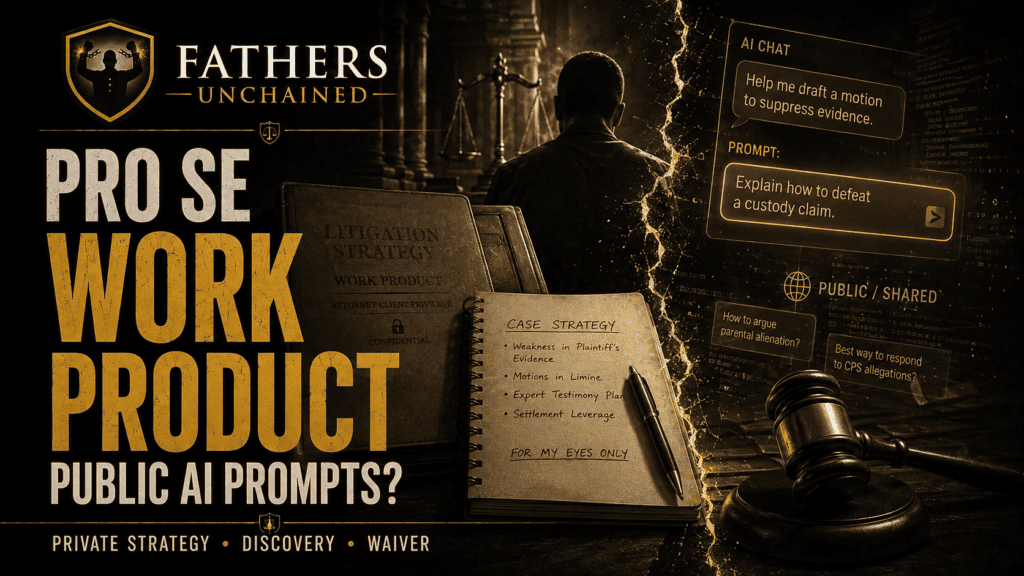
PRO SE LITIGATION • ARTIFICIAL INTELLIGENCE • WORK PRODUCT • DISCOVERY
When You Are Your Own Lawyer, Can the Other Side Demand Your ChatGPT Prompts?
Educational legal analysis only—not legal advice. Work-product protection, privilege, waiver, discovery rules, preservation duties, protective orders, and AI-use rules vary by jurisdiction and case. The law in this area is developing quickly.
For a self-represented litigant, artificial intelligence can become the modern legal pad. A pro se party may use AI to organize a docket, compare authorities, test arguments, draft motions, analyze exhibits, prepare questions, identify weaknesses, or think through litigation strategy before anything is filed with the court.
That creates a new discovery question with an old constitutional and procedural concern:
If you are acting as your own lawyer, can the opposing party demand the private AI conversations you used to prepare your case?
A growing group of 2026 decisions says the answer is not simply yes. Federal Rule of Civil Procedure 26(b)(3) protects certain materials prepared in anticipation of litigation by or for a party, not only materials created by a licensed attorney. Courts in Michigan, Colorado, and New York have now applied that principle to pro se litigants using generative AI.
But the protection is not automatic. The result can change when a represented party independently uses AI, when an unrelated third party creates the material, when confidential discovery is uploaded in violation of a protective order, or when private litigation strategy is deliberately published where an adversary can see it.
Table of Contents
Work Product Is Not the Same as Attorney-Client Privilege
One of the first mistakes in online discussion is calling every private legal conversation privileged. Attorney-client privilege and work-product protection are different doctrines.
Attorney-client privilege generally protects confidential communications between a client and a lawyer made for the purpose of seeking or providing legal advice. An AI system is not your attorney merely because you ask it legal questions.
Work product protects litigation preparation. It is designed to prevent one side from simply obtaining the other side’s preparation, strategy, analysis, and mental roadmap of the case through discovery.
The doctrine originated in Hickman v. Taylor, 329 U.S. 495 (1947), and is now reflected in Federal Rule of Civil Procedure 26(b)(3).
That distinction is especially important for pro se litigants. A self-represented party may have no attorney-client privilege covering his own private legal notes because there is no lawyer on the other side of the communication. But those notes may still be litigation preparation.
Why Rule 26 Matters to a Pro Se Litigant
Federal Rule of Civil Procedure 26(b)(3)(A) generally protects documents and tangible things prepared in anticipation of litigation or for trial by or for another party or its representative.
The wording matters. The rule does not say only material prepared by an attorney.
A person representing himself still has to perform many of the functions a lawyer ordinarily performs:
- reviewing the record;
- researching law;
- testing legal theories;
- deciding what evidence matters;
- drafting pleadings and motions;
- preparing discovery;
- planning cross-examination;
- evaluating settlement positions; and
- identifying strengths and weaknesses before revealing them to an opponent.
The new AI cases are forcing courts to decide whether typing those thoughts into a generative-AI conversation makes them fair game for the other side. Several courts have said no.
Warner v. Gilbarco: ChatGPT Did Not Automatically Waive Protection
On February 10, 2026, the U.S. District Court for the Eastern District of Michigan addressed discovery aimed at a pro se plaintiff’s use of generative AI in Warner v. Gilbarco, Inc.
The court recognized that a pro se litigant may assert work-product protection. It rejected the idea that using ChatGPT automatically destroys that protection. The court relied on the traditional work-product waiver standard: disclosure generally must be made to an adversary, or under circumstances likely to place the material in an adversary’s hands, before waiver becomes the central concern.
The court treated generative AI as a tool rather than the litigant’s adversary. It also emphasized that discovery should not become an excavation of the plaintiff’s private thought processes merely because she used modern technology while preparing her case.
The important point is not that ChatGPT creates a new privilege. It is that using a tool does not automatically erase an existing work-product protection.
Morgan v. V2X: The Pro Se Litigant Is Both Party and Advocate
On March 30, 2026, the U.S. District Court for the District of Colorado went even further in Morgan v. V2X, Inc.
The court distinguished a pro se litigant from a represented client who independently uses AI outside the direction of counsel. A self-represented person has no gap between party and advocate: the same person occupies both roles.
The court concluded that Rule 26(b)(3) can provide some work-product protection for a pro se litigant’s AI-assisted preparation. The court recognized that prompts, analytical choices, and iterative questions can expose what the litigant considers important, what theories are being tested, and how the case is being prepared.
But Morgan also shows the limit. The plaintiff had to identify any AI platform used with information designated confidential under the protective order because the platform’s identity did not itself reveal protected strategy and the producing party had a legitimate interest in knowing whether its confidential material was exposed. The court also strengthened the protective order to restrict confidential discovery from being placed into mainstream AI systems without adequate contractual safeguards.
So Morgan does not say everything involving AI is secret. It separates your litigation preparation from another party’s confidential discovery.
Assini v. Hayward: A Court Quashed a Subpoena to OpenAI
The issue became even more concrete on June 4, 2026, in Assini v. Hayward, a New York Supreme Court case.
The plaintiffs served an amended subpoena on OpenAI seeking a pro se defendant’s prompts, inputs, uploads, outputs, drafts, queries concerning the parties, and materials used to prepare litigation filings and communications.
The court found the reasoning of Morgan persuasive and quashed the subpoena and amended subpoena.
That matters because the dispute was not theoretical. An opposing party actually attempted to obtain a self-represented litigant’s AI account material from the provider. The court refused to treat the mere existence of ChatGPT records as a shortcut into private litigation preparation.
The court also warned that AI use remains subject to court rules and sanctions. Work-product protection is not immunity from accuracy requirements, filing rules, discovery obligations, or judicial supervision.
Build the Record Before You Reveal the Strategy
Fathers Unchained focuses on record-based education for self-represented fathers confronting family-court and government-enforcement systems. Private preparation, source verification, and a clean evidentiary record matter.
Your support funds public education, record-review tools, and source-based research. It is not payment for legal services.
Heppner and Shealy: Where the Protection Can Break Down
The emerging rule is not that all AI conversations are protected.
In United States v. Heppner, a February 17, 2026 criminal decision from the Southern District of New York, a represented defendant independently used Anthropic’s Claude to create defense-related materials. His attorneys had not directed the searches. The court held that the AI materials were protected by neither attorney-client privilege nor the work-product doctrine under the circumstances before it.
Morgan later distinguished Heppner because the pro se setting is fundamentally different. The represented defendant in Heppner was acting independently of counsel; the pro se litigant in Morgan was necessarily performing the advocate’s work himself.
A June 2026 Massachusetts Superior Court decision, Shealy v. Seaside Investments, LLC, provides another warning. A represented party sent dispute documents to his romantic partner, who used ChatGPT to generate a response and other materials without involvement from counsel. The court ordered the materials produced and distinguished Morgan and Warner because those cases involved pro se litigants acting as both party and advocate.
The lesson is important:
Who created the AI material, why it was created, whether the person was pro se, whether counsel directed the work, and who received it can all change the result.
Publicly Available AI Is Not the Same as a Public Prompt
This distinction is critical.
A generative-AI service may be publicly available because anyone can create an account or use a consumer interface. That does not necessarily mean every conversation is publicly visible to the world.
Warner and Morgan both rejected an automatic rule that use of a widely available AI service destroys work-product protection. Morgan specifically recognized that mainstream AI providers may collect or store data while still concluding that this does not automatically eliminate every expectation of privacy or every form of work-product protection.
But that is very different from intentionally making the prompt public.
There are at least four distinct situations:
- Private litigation conversation: a litigant uses an AI tool privately to analyze and prepare the case.
- Provider access or retention: the platform may store, process, or otherwise handle the user’s data under its terms.
- Public sharing: the litigant posts screenshots, publishes the conversation, creates a public share link, or otherwise exposes the strategy.
- Protected third-party material: the litigant uploads confidential discovery or information subject to a protective order.
Those are not the same legal problem.
What Happens If You Publish the Prompt?
Work-product waiver is generally narrower than attorney-client waiver. In Warner, the court emphasized that waiver focuses on disclosure to an adversary or disclosure in a way likely to put the material into an adversary’s hands.
That is why a public social-media post, public website, unrestricted share link, or public screenshot can create a much stronger waiver argument than private use of an AI tool.
Imagine a pro se plaintiff privately asks:
“What are the three weaknesses in my jurisdiction argument, and how is the defendant most likely to attack them?”
That prompt may expose strategy, weaknesses, anticipated defenses, and the litigant’s assessment of the case.
If the conversation remains part of private litigation preparation, there may be a serious work-product argument under the emerging cases.
If the same conversation is voluntarily published where opposing counsel can read it, the litigant has created a very different problem. Public disclosure can support an argument that the confidentiality expected of litigation preparation has been abandoned or that disclosure was made in a manner substantially likely to reach the adversary.
That does not mean every public statement about a case waives every piece of work product. A litigant can advocate publicly without publishing his entire internal strategy. The danger is exposing the private analytical process itself.
Do Not Upload Protected Discovery Just Because Your Own Strategy May Be Protected
Morgan is particularly useful here because it separates two rights and duties that people often mix together.
Your own analysis may receive work-product protection. But documents the opposing party produced under a confidentiality agreement or protective order remain subject to that order.
If an order prohibits disclosure to unauthorized third parties or requires specific security safeguards, uploading the material to a consumer AI system can create a separate violation even if the questions you ask about it would otherwise reveal your litigation strategy.
Always read the protective order before placing discovery into any external service.
AI Prompts as the Modern Legal Pad
Before generative AI, a lawyer or pro se litigant might prepare a case using:
- handwritten legal-pad notes;
- draft motions;
- research queries;
- outlines;
- timelines;
- deposition questions;
- private memoranda;
- lists of weaknesses and counterarguments; and
- alternate versions of an argument that were never filed.
AI can combine all of those activities into one conversation.
A prompt history may reveal more than the final motion ever could. The final filing tells the opponent what argument you chose. The private AI conversation may reveal the arguments you rejected, the weaknesses you identified, the evidence you fear, the witnesses you are considering, and the strategy you intend to use next.
That is why discovery of an entire AI history can become the digital equivalent of demanding an opposing lawyer’s litigation notebook.
For pro se litigants, the 2026 cases recognize an access-to-justice concern as well. Represented parties may have lawyers, proprietary research databases, paralegals, litigation-support platforms, and private AI tools. A self-represented person may be using mainstream AI simply to perform the basic analytical work necessary to participate in the adversarial system.
What If the Other Side Demands Your AI History?
A demand for AI prompts should be analyzed like any other discovery request. Do not assume it must be produced, and do not assume it can automatically be withheld.
Questions to examine include:
- Was the material created because of pending or reasonably anticipated litigation?
- Were you pro se when it was created?
- Does the request seek underlying facts, or does it seek your mental impressions and strategy?
- Was the conversation ever shared with the adversary or made public?
- Did you upload confidential material belonging to another party?
- Is the request proportional and relevant to a claim or defense?
- Does state or federal work-product law apply?
- Is a privilege or work-product log required?
- Should the request be narrowed, objected to, or addressed through a protective order or motion to quash?
Assini is particularly important because it demonstrates that an overbroad subpoena to an AI provider can itself become the subject of a motion to quash.
Preserve It—Do Not Destroy It
Work-product protection is a basis for resisting or limiting disclosure. It is not permission to destroy material.
Once litigation is pending or reasonably anticipated, preservation duties can apply to relevant electronically stored information. Deleting AI conversations because an opponent might request them can create spoliation issues far more serious than the original discovery dispute.
The safer distinction is simple:
Preserve first. Then assert the correct protection through the proper discovery procedure.
And before filing anything generated with AI, independently verify the authorities, quotations, record citations, and factual assertions. Work-product doctrine does not protect a litigant from sanctions for false citations or inaccurate filings.
Frequently Asked Questions About ChatGPT Prompts and Work Product
Are ChatGPT prompts discoverable in litigation?
Potentially, but not automatically. Courts are beginning to distinguish between ordinary discoverable facts and private litigation preparation that may qualify for work-product protection. The result depends on who created the material, why it was created, whether it was shared, and what law applies.
Can a pro se litigant claim work-product protection for AI prompts?
Yes, in some circumstances. Federal Rule of Civil Procedure 26(b)(3) protects certain materials prepared in anticipation of litigation by or for a party, and several 2026 decisions have recognized that a self-represented litigant can invoke work-product protection for AI-assisted case preparation.
Does using ChatGPT waive work-product protection?
Not by itself. Courts have rejected the idea that using a mainstream AI tool automatically waives work-product protection. Waiver concerns become much stronger when the material is disclosed to an adversary or intentionally made public.
Can opposing counsel subpoena OpenAI for a litigant’s prompts?
They can attempt to do so, but that does not mean the subpoena will be enforced. In Assini v. Hayward, a New York court quashed a subpoena seeking a pro se litigant’s OpenAI materials because the request reached into protected litigation preparation.
Should a litigant delete AI conversations after receiving a discovery request?
No. Potentially relevant AI conversations should be preserved. Work-product protection is a basis for resisting or limiting disclosure through proper procedure; it is not permission to destroy potentially relevant evidence.
Primary Sources
- Hickman v. Taylor, 329 U.S. 495 (1947)
- Federal Rule of Civil Procedure 26(b)(3)
- Warner v. Gilbarco, Inc., E.D. Mich., Feb. 10, 2026
- Morgan v. V2X, Inc., D. Colo., Mar. 30, 2026
- Assini v. Hayward, 2026 NY Slip Op 26086 (June 4, 2026)
- United States v. Heppner, S.D.N.Y., Feb. 17, 2026
- Shealy v. Seaside Investments, LLC, Mass. Super. Ct., June 2026
Related Fathers Unchained Reading
- The Jurisdiction Problem Most Courts Ignore
- Here Is How You Do It! — Part 1: Was Personal Service Proper?
- Why Federal Courts Avoid Family Court Cases — And How to Appeal When Constitutional Rights Are Ignored
The Bottom Line
The law is not creating a special “AI privilege.” It is applying old litigation protections to a new tool.
A pro se litigant can potentially invoke work-product protection because Rule 26 protects litigation material prepared by a party, and a self-represented litigant necessarily acts as both party and advocate. Warner, Morgan, and Assini show that private AI-assisted research and strategy are not automatically discoverable merely because ChatGPT or another AI tool was involved.
But Heppner and Shealy show why the facts matter. A represented party acting independently, an unrelated helper, disclosure outside the litigation team, platform confidentiality, protective orders, and public sharing can change the result.
If AI is functioning as your modern legal pad, treat it like a litigation file—not like a public social-media feed.
Use it to think. Verify what it gives you. Preserve the record. Protect confidential material. And understand that publishing your internal litigation strategy can hand the other side something discovery might never have entitled them to obtain.
Fathers Unchained Commentary: This article provides educational analysis of work-product doctrine, pro se litigation, discovery, and artificial intelligence. It does not establish whether any specific AI conversation is protected and is not legal advice.