

Here Is How You Do It! — Part 1: Was Personal Service Proper?
PERSONAL SERVICE & RETURNS
Test the Return, Find the Authority, and Preserve the Issue Before You Fight the Case
Educational information only—not legal advice. Court rules, statutes, deadlines, waiver doctrines, and available remedies vary by jurisdiction and can change. Verify the law that governed when the relevant acts occurred.
Table of Contents
Before You Argue the Case, Ask What the Record Proves
A court file may contain years of orders, calculations, enforcement notices, and hearing entries. But before debating what the court decided, there is a threshold question worth asking:
What does the record prove about how the person was first notified and brought into the case?
Filing a complaint or petition opens a case. It does not, by itself, prove that the responding party was served. A docket entry may summarize service, but the underlying summons, citation, return, affidavit, receipt, or proof of publication usually shows the details that matter.
The Supreme Court explained in Murphy Brothers, Inc. v. Michetti Pipe Stringing, Inc., 526 U.S. 344 (1999), that a named defendant ordinarily is not required to participate in civil litigation merely because someone informally delivered a complaint. Formal process matters because it supplies legally recognized notice and invokes the court’s authority under the governing rules.
That does not mean every service defect automatically defeats a case. It means the issue must be tested against the correct authority, the correct documents, and the correct timeline.
Four Different Questions That Should Not Be Blended Together
A strong record-based review separates four issues:
- No service: Was any authorized method of service completed at all?
- Defective service: Was something delivered, but by the wrong person, to the wrong recipient or address, outside the permitted time, or through a method the rule did not authorize?
- Defective or missing proof: Did service occur, but the return or affidavit contain an omission, remain unfiled, or require amendment?
- Waiver or later conduct: Did an appearance, filing, agreement, or failure to object affect the service or personal-jurisdiction issue under that jurisdiction’s law?
Those are not interchangeable. For example, Federal Rule of Civil Procedure 4(l)(3) provides that a failure to prove service does not itself invalidate service and permits a court to allow amended proof. State rules may follow a similar rule, use a different rule, or treat certain omissions as more serious. That is why “there is no return in the file” can be an important fact without always being the end of the analysis.
Why the Return of Service Matters
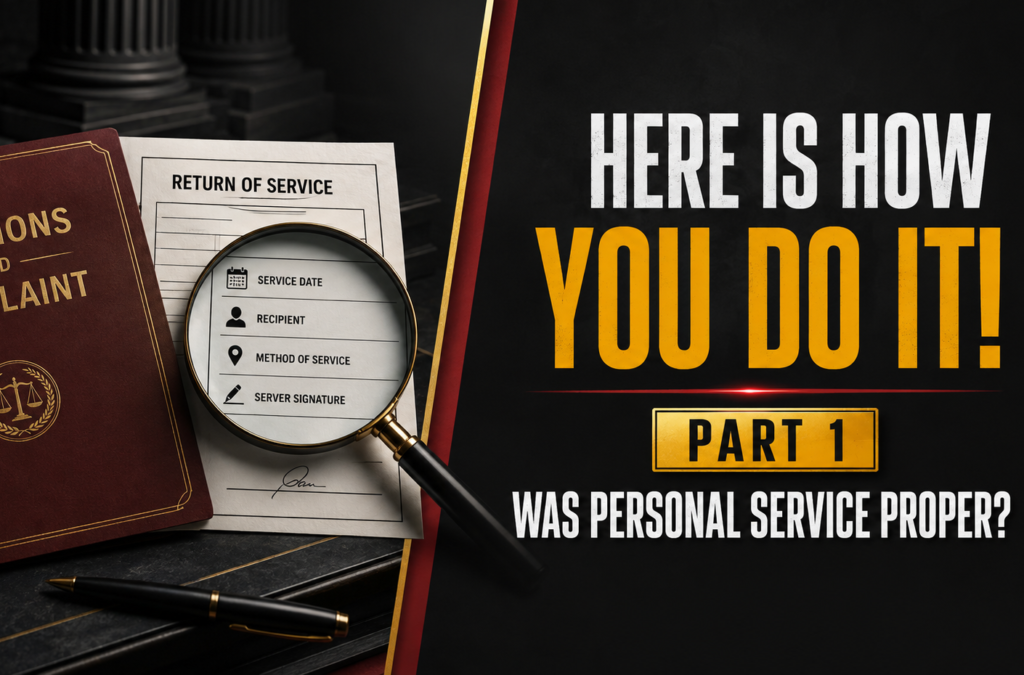
A return or affidavit of service is the server’s formal account of what occurred. Depending on state law and the type of proceeding, it may need to identify:
- who served the papers and whether that person was legally qualified;
- which documents were delivered;
- the person who received them;
- the date, time, and place of delivery;
- the method used;
- facts supporting substituted delivery to another person or location;
- whether the statement was signed, sworn, notarized, or made under penalty of perjury; and
- when and where the proof was filed.
The return is not merely paperwork to glance at. It is a factual statement that can be compared line by line with the governing rule. A precise comparison is far more persuasive than saying only, “I was never served.”
When Personal Service Gives Way to Alternative Service
If personal service was not completed, the case may turn to publication, posting, certified or ordinary mail, delivery to another person, electronic service, or another court-authorized method. Alternative service can be valid—but only if the governing law permits it and its prerequisites were satisfied.
The file may need to show a diligent-search affidavit, a motion requesting another method, an order identifying the authorized method, completion of that method, and proof filed afterward. These are separate steps. Permission to use alternative service is not proof that the authorized service was actually carried out.
Constitutional notice and rule compliance are related but distinct. In Mullane v. Central Hanover Bank & Trust Co., 339 U.S. 306 (1950), the Supreme Court measured notice by whether the chosen method was reasonably designed, under the circumstances, to inform affected people and allow them to object. The Court treated publication differently for people whose addresses were unknown and those whose whereabouts were known.
Likewise, Jones v. Flowers, 547 U.S. 220 (2006), teaches that when the government learns a notice attempt failed, additional reasonable steps may be required if practical. But due process does not always demand proof of actual receipt; the method, the information available at the time, and the governing procedural rules all matter.
How the Two Authority Tools Help
The Personal Service and Return State Authority Tool starts with a federal overview and lets the reader select a state. Its complete saved report organizes the rules governing who may serve, personal and substituted delivery, service on agents or entities, mail and waiver procedures, server qualifications, returns and affidavits, completion rules, defects, limitations, record-review questions, and source links.
If the docket or file points to publication, posting, mail, electronic service, or another substitute method, the Alternative Service State Authority Tool becomes the next step. Its saved report organizes state statutes, court rules, cases, procedural prerequisites, proof requirements, limitations, and questions to ask of the record.
The Objection and Preservation Log completes the workflow. It gives the reader a structured place to record the issue, governing authority, supporting document or missing-record response, objection date, filing, hearing, ruling, deadline, and next step. Research identifies the problem; documentation helps preserve it.
These tools do not decide whether service was valid, replace the complete case file, or guarantee a result. They give the reader a disciplined research map: find the rule, identify each required step, locate the document that should prove it, and record the gap when the document is missing.
Start With the Governing Authority
Use the resources in sequence: identify personal-service requirements, review alternative service when the record points to a substitute method, and document every objection and preservation step as the case develops.
What to Do If the Tool Does Not Find an Authority
An unavailable result is not proof that no law exists. It means the research is not complete. Treat it as a research gap—not as a legal conclusion.
- Document the search. Record the state, topic, date searched, search terms, and the result shown. Save a PDF or screenshot for your research file.
- Go to official sources. Check the state judiciary’s current rules, the official legislature or code site, administrative rules where relevant, and published appellate decisions.
- Check the historical version. The rule in force when service allegedly occurred may differ from today’s rule. Look for amendment histories, archived rule books, session laws, and effective dates.
- Check local and case-specific authority. Standing orders, local court rules, special family-court rules, and an order entered in the individual case may affect the method or required proof.
- Search by concept, not only by label. A state may use terms such as substitute service, constructive service, service by publication, citation, diligent inquiry, warning order, order of notice, or service by mail.
- State negative research honestly. If no reported decision addresses the exact fact pattern, say what sources were searched and what was not located. Do not turn “not found” into “does not exist.”
A law librarian can often help locate historical rules and reporters. A clerk can identify what is in the court file and explain record-access procedures, but usually cannot give legal advice or decide whether service was valid.
How to Build the Record Properly
1. Freeze the Timeline
Create a dated chronology that includes:
- the filing date of the complaint or petition;
- the date the summons, citation, or order of notice was issued;
- each alleged attempt at personal service;
- any motion and affidavit requesting alternative service;
- the order authorizing a different method;
- publication, mailing, posting, or electronic-transmission dates;
- the date any return or affidavit was filed;
- the first order affecting rights, property, income, custody, or liberty;
- the first date the responding party learned of the case; and
- every appearance, objection, motion, and ruling that followed.
Do not rely on memory alone. Tie each date to a docket entry, filed document, envelope, receipt, transcript, or other source.
2. Request the Complete File, Not Just the Docket
Ask for identifiable records, preferably in writing. Depending on the case, the request may include:
- the original complaint or petition and all amendments;
- the issued summons, citation, writ, or order of notice, including the reverse side;
- every return, affidavit, certificate, or waiver of service;
- motions, affidavits, and exhibits offered to obtain alternative service;
- the order authorizing alternative service;
- publisher affidavits, tear sheets, publication invoices, or certificates;
- mailing certificates, tracking records, signed receipts, and returned envelopes;
- electronic-service records or delivery confirmations;
- orders entered before the alleged service date; and
- the certified docket or register of actions.
Request certified copies when certification matters to the intended use. If a specific record cannot be located, ask whether the court provides a certificate or statement of no record. Some clerks will certify only the results of a records search, not a legal conclusion. If the request is denied or the office will not issue such a certificate, preserve the written request and response.
Judicial case records are often governed by court-access rules rather than ordinary public-records or FOIA procedures. Use the process that applies to the specific custodian.
3. Build a Requirement-to-Record Comparison
Create a working chart with five columns:
| Required step | Authority | Record evidence | Gap or conflict | Exhibit |
|---|---|---|---|---|
| Authorized server | Rule or statute | Name and qualifications on return | Missing identity or qualification | Exhibit A |
| Required delivery | Rule or order | Date, place, recipient, method | Method or recipient differs | Exhibit B |
| Diligent search | Alternative-service authority | Affidavit and described efforts | No affidavit or conclusory effort | Exhibit C |
| Completion and proof | Rule, order, or publication requirement | Return, receipt, or publisher affidavit | Authorization shown; execution not shown | Exhibit D |
This format forces the challenge to remain verifiable. It also helps a lawyer, judge, or reviewing court see the issue without reconstructing the file from scattered accusations.
4. Use a Factual Declaration Carefully
A declaration or affidavit should state facts within the signer’s personal knowledge: where the person lived, which addresses were valid, whether papers were received, when the case was first discovered, and what records were requested. Attach documents that corroborate those facts where appropriate.
A personal declaration should not pretend to prove what the clerk, server, publisher, or opposing party did not do. It also should not substitute a legal conclusion—such as “the judgment is void”—for the documentary comparison the court must evaluate.
5. Preserve the Issue in the Correct Proceeding
A research file does not preserve an objection by itself. The issue generally must be presented through the procedure authorized in that jurisdiction, within any applicable deadline, and before a tribunal with power to grant the requested relief.
A focused filing should identify the exact rule, the exact record evidence, the precise omission or conflict, and the relief requested. Depending on the case and governing law, relief might involve production of records, additional time, an evidentiary hearing, correction of the return, dismissal, setting aside a default, vacatur, or a stay. The correct vehicle and timing require state-specific analysis.
Ask for a clear ruling. Preserve the hearing notice, filed objection, exhibits, transcript or recording request, and resulting order. If the court relies on evidence not already in the record, identify and request that evidence.
6. Serve Your Own Filing Correctly
A service challenge can lose credibility if the challenger ignores the rules for filing and serving the challenge. Follow the current requirements for captions, signatures, certificates of service, electronic filing, copies, exhibits, and notice to all required parties.
What Makes a Service Challenge Persuasive
The most persuasive presentation is usually narrow, documented, and restrained:
- Lead with the controlling rule—not a broad accusation.
- Quote or paraphrase only the portion that governs the disputed step.
- Place the filed return, affidavit, order, or missing-record response beside that requirement.
- Separate a defect in service from a defect in proof.
- Address possible amendment, waiver, appearance, actual-notice, and alternative-service arguments.
- Avoid alleging fraud unless evidence supports each element of that accusation.
- Ask for relief the tribunal is authorized to grant.
In Peralta v. Heights Medical Center, Inc., 485 U.S. 80 (1988), the Supreme Court held that a judgment entered without constitutionally adequate notice or service could not be preserved merely because the affected person had not shown that the underlying merits would come out differently. The lesson is powerful—but it must be tied to proof that the service or notice failure actually occurred under the applicable law.
What Not to Do
- Do not assume a docket notation is the complete proof of service.
- Do not assume a missing return conclusively proves no service.
- Do not treat a current rule as automatically controlling an older case.
- Do not confuse authorization for alternative service with proof of completion.
- Do not rely only on a private summary when an official rule or opinion is available.
- Do not ignore deadlines while researching jurisdiction.
- Do not bury the strongest defect beneath unrelated grievances.
Frequently Asked Questions
Does a missing return prove that service never occurred?
Not always. Some rules allow proof to be filed late or amended, and some distinguish the act of service from proof of service. The missing document is a reason to investigate and preserve the issue, not an automatic conclusion.
Does actual knowledge cure improper service?
That depends on the governing law and procedural posture. Informal knowledge and formal service are not always equivalent, but waiver, appearance, objection deadlines, and curable defects can affect the result.
Is service by publication automatically invalid?
No. Publication may be authorized when a person cannot be located through the efforts required by law. The questions are whether the prerequisites were satisfied, the court authorized the method when authorization was required, the method was completed exactly as ordered, and the notice was constitutionally reasonable under the circumstances.
Does every service error make a judgment void?
No. Courts distinguish jurisdictional failures from technical, amendable, waived, or harmless defects. The controlling state authority and complete record determine which category fits.
Can an authority report replace an attorney?
No. The reports organize educational research and source links. They do not apply law to every fact, choose a procedural vehicle, calculate deadlines, or create an attorney-client relationship.
Primary Authorities and Research Starting Points
- Murphy Brothers, Inc. v. Michetti Pipe Stringing, Inc., 526 U.S. 344 (1999)
- Mullane v. Central Hanover Bank & Trust Co., 339 U.S. 306 (1950)
- Peralta v. Heights Medical Center, Inc., 485 U.S. 80 (1988)
- Jones v. Flowers, 547 U.S. 220 (2006)
- Dusenbery v. United States, 534 U.S. 161 (2002)
- Current Federal Rules of Civil Procedure (federal cases only; state proceedings require state-specific authority)
Next in This Series
Here Is How You Do It! — Part 2: Is Your Income Withholding Order Valid?
Before they take your paycheck, Part 2 will test the issuing authority, required language, underlying support order, notices, employer instructions, withholding limits, signatures and identifiers, and proof in the record showing how the order was issued and executed.
The Bottom Line
Personal service and returns matter because the record must support the authority being exercised. But a successful challenge is not built from a slogan. It is built by separating service from proof, personal service from alternative service, current law from historical law, and factual gaps from legal conclusions.
Use the authority tools to identify the rule. Use certified records to establish what the file contains. Use a dated comparison to show what matches and what does not. Then preserve the issue through the procedure the governing law actually provides.
Fight back with the record—because the record is what a reviewing court can examine.
Put the Research Into a Practical Review Pathway
The authority tools help identify the governing rules. The records and cataloging tools help you compare those rules with what the file actually contains. The four-step Record Review Pathway brings the work together: identify the issue, collect the record, compare authority to evidence, and organize the next step.
Educational resources only—not legal advice. Verify current and historical authority, local requirements, deadlines, and the complete record before deciding what procedure or relief may be available.