
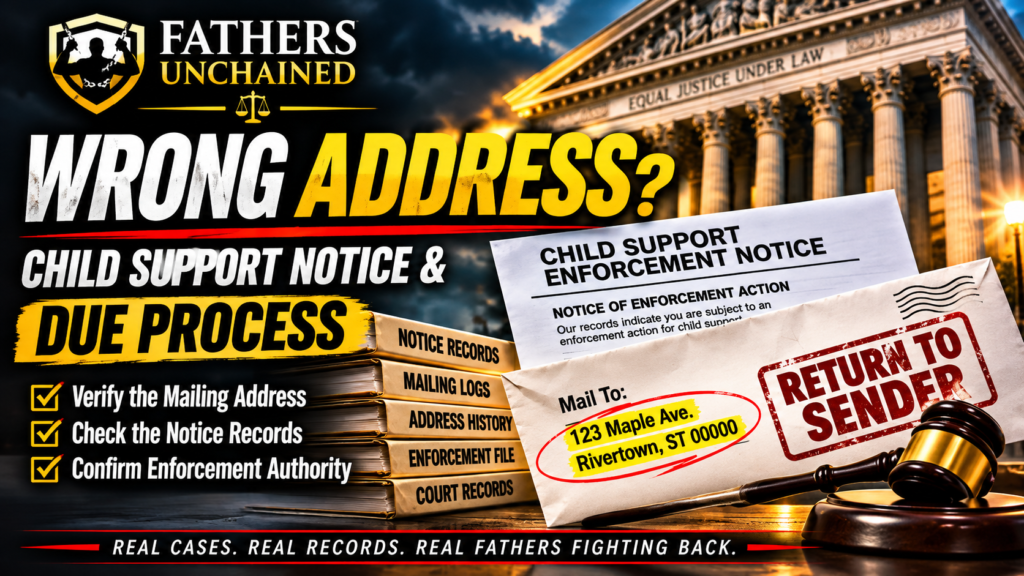
Child Support Notice Sent to the Wrong Address? Check These Records Before Challenging Enforcement
November 2, 2026 | Fathers Unchained
Imagine discovering that your wages are being garnished, your driver’s license has been suspended, or your tax refund has been intercepted because of a child support enforcement action. You contact the agency and explain that you never received notice. Their response? “We mailed the notice to the address on file.”
But what if that address was wrong? What if you never lived there? What if the agency had a newer address? Or what if the records do not establish when the notice was sent?
These are questions worth investigating before filing another motion or making accusations you cannot yet prove. At Fathers Unchained, our approach is simple: Don’t begin with what the agency says happened. Begin with what the records establish.
START WITH YOUR RECORD — FATHERS UNCHAINED
Table of Contents
- Why the address matters
- Original service versus later enforcement notices
- Seven records you should request
- What federal law actually says
- Build your own notice timeline
- What to do when the address is wrong
- Sample written records request
- Mistakes to avoid
- Frequently asked questions
- Take control of your record
1. Why the Address Matters
A government agency may have legal authority to enforce a valid child support obligation. But that authority does not eliminate applicable requirements for notice, administrative review, or judicial process.
The United States Supreme Court explained in Mullane v. Central Hanover Bank & Trust Co., 339 U.S. 306 (1950), that due process generally requires notice reasonably calculated, under the circumstances, to inform affected individuals and provide an opportunity to respond. This does not mean every notice must be personally delivered or actually received. The method of notice, the circumstances, and the governing law matter.
Suppose an agency sends a suspension notice to an address you left years earlier. Ask: What address was legally on file? When was that address provided or updated? Did the agency follow applicable notice requirements? Did it receive returned mail or learn of an address problem? What records establish the date and method of notice? Was there an opportunity to contest the action?
Without the records, you may be arguing assumptions rather than proving facts.
2. Original Service and Enforcement Notices Are Not the Same Thing
Original service of process concerns how a court or authorized tribunal obtained personal jurisdiction when the case began. Subsequent notice concerns later steps such as hearings, administrative collection, license suspension, or enforcement. Agency enforcement records concern what the agency actually did and the supporting documentation.
Each category can involve different rules and deadlines. An error in a later notice does not automatically establish that the underlying judgment is void. Conversely, a valid original judgment does not excuse every later procedural defect.
If you are investigating the beginning of the case, read Was Personal Service Proper? Requirements, Returns, Proof and Challenges.
3. Seven Records You Should Request
Record 1: The actual notice
Ask for the notice associated with the challenged action, including its date, intended recipient, mailing address, and response instructions.
Record 2: Mailing or delivery records
Request available mailing logs, electronic-notice records, certified-mail information, or vendor records showing the transmission date and method. Do not assume a particular mailing method was required before checking the law.
Record 3: Address history
Request available records identifying the addresses maintained for you, the dates changes were made, and the source of those changes. Pay attention to the information filed with the state case registry.
Record 4: Returned mail and contact notes
Ask whether the agency documented returned correspondence, failed delivery, address corrections, or later contact attempts.
Record 5: Court orders and docket entries
Get the actual signed order, later modifications if any, and docket entries relevant to the enforcement action. A docket summary is not the same as the underlying order.
Record 6: Enforcement referral or certification
Identify the document initiating the specific measure, whether a license suspension, tax-offset certification, or income-withholding action. Each may operate under its own requirements.
Record 7: Review and appeal records
Request the applicable administrative review and appeal procedures, along with any agency decision already made.
Federal recordkeeping duties do not guarantee unrestricted access to every internal document. Access depends on state law, applicable confidentiality rules, and the proceeding.
4. What Federal Law Actually Says
42 U.S.C. § 666(c)(2)(A) is especially relevant to the state case registry and notice in subsequent child support enforcement actions. It requires state procedures for filing and updating location information. Under specified conditions, including a sufficient showing of diligent location efforts and delivery of written notice to the most recent residential or employer address filed with that registry, state due-process notice and service requirements can be deemed satisfied for a subsequent enforcement action.
Therefore investigate both the address used for notice and the information actually filed in the state case registry. Read 42 U.S.C. § 666.
45 C.F.R. § 303.2(c) requires a Title IV-D case record to be supplemented with relevant information, documents, facts, dates, actions, contacts, and results. It helps frame precise record questions, although it does not itself grant unrestricted access to the full agency file. Read 45 C.F.R. § 303.2.
These sources are a framework for inquiry, not proof that any particular notice or enforcement action is invalid.
5. Build Your Own Notice Timeline
Organize the events chronologically and put the supporting document beside each entry:
| Date | Event | Supporting record |
|---|---|---|
| March 5 | Address updated | Registry entry |
| April 12 | Notice generated | Agency notice |
| April 14 | Notice mailed to older address | Mailing record |
| May 20 | Enforcement initiated | Agency certification |
| June 3 | Parent learns of action | Employer or agency letter |
If the registry had already been updated, the factual question becomes: Why was the old address used? That question can be investigated against documents instead of assumptions.
6. What to Do When the Address Is Wrong
- Identify the specific enforcement action and its deadline. A pending hearing, review, or appeal period may require action now. Do not wait for an open-records response if a deadline is running.
- Request the supporting records from the agency and court clerk as appropriate. Save proof you sent the requests.
- Compare the documents with your state’s actual notice rules. Distinguish mailing requirements, address registry requirements, and review procedures.
- Document address corrections. Keep dated acknowledgements, correspondence, returned mail, and other reliable records.
- Use the procedure that fits the issue. Depending on the state and action, this may involve an administrative review, hearing, objection, appeal, or a court motion.
A records request ordinarily does not suspend enforcement or extend a filing deadline.
7. Sample Written Records Request
Subject: Request for Notice, Address, and Enforcement Records
I am requesting copies of records associated with the notice and enforcement action concerning case number [CASE NUMBER].
Please provide the notice relied upon, available mailing or delivery records, relevant address-history entries, returned-mail records, the underlying enforcement referral or certification, and applicable administrative review procedures.
Please identify the statute or regulation governing the notice method used for this action.
I request a written response identifying any responsive records withheld or unavailable, together with the applicable basis for withholding where required.
This request concerns the accuracy and completeness of the record associated with the enforcement action.
Send your request through an authorized agency channel. Keep confirmation of submission. You may need separate requests to the court clerk or another office.
8. Mistakes to Avoid
- Assuming nonreceipt automatically makes an order void. Legally sufficient notice does not always require actual receipt.
- Confusing original service with later enforcement. They involve different questions and remedies.
- Claiming fraud without evidence. A discrepancy should be investigated; it is not, standing alone, proof of deliberate misconduct.
- Missing a deadline while waiting for records. A time-sensitive challenge may require immediate procedural action.
- Assuming a challenge automatically stops collection. An order or measure generally remains effective unless modified or stayed through an authorized process.
9. Frequently Asked Questions
What if I never lived at that address?
Preserve evidence supporting that fact and obtain the records showing how the address entered the agency’s system. Whether notice was legally adequate requires further analysis.
What if I notified the agency of my new address?
Look for dated evidence and determine whether the relevant case-registry information was updated before the notice was sent.
Can I challenge enforcement without reopening the entire case?
Sometimes a separate administrative or judicial process exists. The grounds and remedies depend on the specific action and jurisdiction.
What if the arrears balance is also wrong?
That’s a separate accounting issue. Compare the signed orders, payment ledger, adjustments, and claimed amount. See Child Support Amount Looks Wrong? How to Audit the Number.
10. Take Control of Your Record
Don’t guess what happened. Identify the document, the legal requirement, and the difference between what was required and what the record actually establishes. The same principle applies to fathers, mothers, and other parents affected by enforcement.
Find the record. Read the record. Verify the authority. Then determine your next step.
Start With Your Record — Fathers Unchained
Fathers Unchained provides educational resources to help locate court records, review service and enforcement documents, build timelines, and identify questions. Explore our Case Record Audit service if you need a more structured educational review.
START YOUR RECORD REVIEW AT FATHERS UNCHAINED
Fathers Unchained provides educational information, not legal representation or individualized legal advice. Rules and deadlines vary by jurisdiction. Consult qualified counsel where appropriate, particularly when enforcement or appeal deadlines are pending.