

Justice Jackson’s Emergency-Powers Dissent Raises a Bigger Question: When Does Government Harm Merit Immediate Relief?
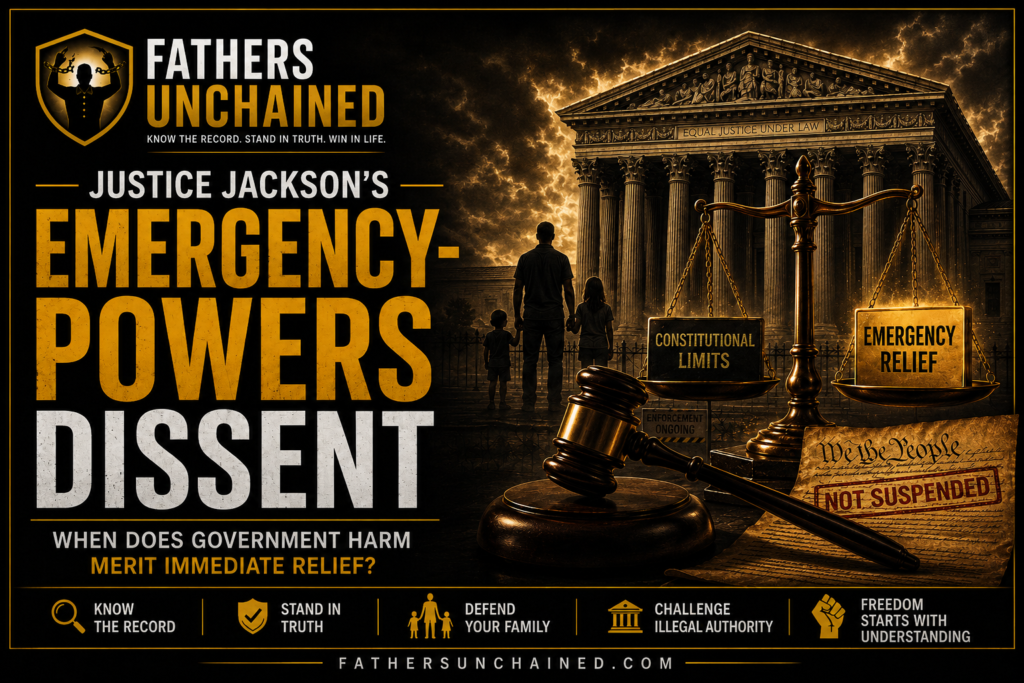
SUPREME COURT • EMERGENCY RELIEF • DUE PROCESS
What Justice Jackson’s Emergency-Powers Dissent Says About Government Harm While Constitutional Questions Remain Unresolved
Commentary and educational analysis only—not legal advice. This article links to primary court sources so readers can review the record and draw their own conclusions.
On August 24, 2026, the Supreme Court granted the federal government’s stay application in Trump v. California, No. 26A124. Justice Ketanji Brown Jackson dissented, describing the Court’s decision as a “serious legal error” and a “grave misuse” of its emergency equitable powers. Her reasoning arose in an election-law dispute, but the principle she emphasized reaches much further: what should courts do when government action continues while the legal authority for that action remains contested?
Table of Contents
Why This Dissent Matters Beyond Election Law
The dispute in Trump v. California concerned federal directives affecting state vote-by-mail systems. A federal district court had entered an injunction, and the federal government asked the Supreme Court to stay that injunction while the litigation continued. The Court granted the request. Justice Jackson dissented.
What makes the dissent relevant outside election law is the way Jackson framed emergency equity. She focused not only on threshold doctrines such as standing and ripeness, but also on the practical consequences of letting challenged government conduct move forward before the underlying legal dispute was resolved. The Supreme Court docket for No. 26A124 shows that Jackson requested a response, referred the application to the full Court, and then dissented when the stay was granted.
That does not mean every allegation of unlawful government action warrants an injunction. It does mean that emergency relief exists because time is sometimes part of the injury. A court can ultimately rule on the merits and still leave a litigant with consequences that cannot be fully reconstructed after the fact.
Jackson’s Emergency-Equity Argument
Jackson’s dissent emphasized that a stay application calls for an equitable judgment, not merely a procedural checklist. She criticized the majority for allowing the government to proceed even though, in her view, the government had not adequately defended the underlying legal authority for the challenged directives. Her focus was therefore partly institutional: courts should consider what the government is doing, what authority it claims, and what happens to affected parties while litigation remains pending.
Whether one agrees with Jackson’s election-law conclusions or not, that framework raises a broader due-process question. If government conduct may exceed lawful authority and the consequences accumulate during review, should courts treat delay as neutral? Or should emergency equity account for the real-world harm occurring before final judgment?
That is the principle worth examining: government action does not become harmless merely because litigation is still pending.
Compare the Principle With Van Etten v. Fattman
Less than five weeks before Jackson issued her Trump dissent, another emergency application reached her chambers. In Van Etten v. Fattman, Supreme Court No. 26A97, Gregory Alvin James Van Etten sought a stay of continuing Massachusetts child-support enforcement while his First Circuit appeal remained pending. The official Supreme Court docket records that the application was submitted to Justice Jackson on July 16, docketed July 21, and denied on July 22 without an explanatory opinion.
The application arose from a civil-rights case centered on a threshold personal-jurisdiction dispute. Van Etten maintains that the certified state-court record does not establish completion of service before the Massachusetts Probate and Family Court began exercising coercive authority over him. His federal appeal has also challenged continuing enforcement allegedly derived from orders entered before personal jurisdiction attached.
The denial of 26A97 should not be described as a Supreme Court determination that Massachusetts acted constitutionally. The order contains no such reasoning. It was a denial of emergency relief without an explanatory opinion. That distinction matters because it prevents the comparison from becoming something the public record does not support.
The Cases Are Different — And That Matters
Trump v. California and Van Etten v. Fattman are not procedurally identical. In Trump, a federal district court had already entered an injunction and the federal government asked the Supreme Court to lift its effect while the appeal proceeded. In Van Etten, the federal district court had dismissed the civil-rights action, the First Circuit had denied interim relief, and Van Etten asked the Supreme Court to affirmatively halt continuing state enforcement during the appeal.
Those differences affect the status quo, likelihood-of-success analysis, federal jurisdiction, and the traditional stay factors. A fair comparison therefore cannot simply say: Jackson opposed government action in one case and permitted it in another. The legal posture matters.
But acknowledging the differences does not eliminate the larger question. It sharpens it: how consistently should courts apply the principle that potentially unauthorized government action can create serious harm while threshold procedural questions remain unresolved?
Does the Principle Change Depending on Who Is Asking?
Justice Jackson’s dissent offers a forceful conception of emergency equity when government power is at issue. The broader concern is whether that same sensitivity to continuing harm is available to ordinary individuals confronting state enforcement systems, especially when they lack institutional resources, government counsel, or the ability to absorb years of litigation.
Consider the family-enforcement context. A citizen may contend that the record contains no completed return of service, no proof that court-authorized publication was actually completed, and no sufficient evidence establishing personal jurisdiction before coercive orders were entered. Meanwhile, enforcement may continue through withholding, liens, levies, offsets, credit reporting, license-related mechanisms, or other collection activity.
At some point the question becomes larger than the eventual merits: what happens while everyone waits? That is the same category of equitable concern Jackson emphasized in Trump, even though the governing doctrines and procedural posture may differ.
Why “You Can Challenge It Later” Is Not Always a Remedy
This is one of the most consequential problems in prolonged enforcement litigation. Courts may eventually decide whether an order, enforcement mechanism, or jurisdictional theory was lawful. But enforcement operates in real time. Money can be withheld, accounts can be restrained, credit can be affected, employment opportunities can be impaired, and liens, offsets, license-related consequences, or other enforcement tools can continue while the case moves through multiple levels of review.
A later victory cannot always reconstruct the intervening years. That is why emergency equitable relief exists in the first place: not to decide every ultimate issue prematurely, but sometimes to preserve the possibility that judicial review will still be meaningful when it ends.
For a deeper discussion of how federal courts often approach family-court-related constitutional claims, see Why Federal Courts Avoid Family Court Cases — And How to Appeal When Constitutional Rights Are Ignored.
Personal Jurisdiction Is Not a Technicality
Personal jurisdiction is not simply a paperwork dispute. Before a court may exercise coercive authority over a person, the legal system requires a jurisdictional basis and constitutionally adequate notice. The exact rules vary by jurisdiction, and a missing proof document does not automatically establish that service never occurred. But the underlying question remains fundamental: what record evidence shows that lawful authority over the person attached before coercive orders were entered?
That is why Fathers Unchained emphasizes separating authorization from completion. An order allowing alternative service is not necessarily proof that the authorized method was actually carried out. The return, affidavit, publication proof, receipt, docket, and governing rule must be compared carefully. See Here Is How You Do It! — Part 1: Was Personal Service Proper? and Understanding Void Service and Jurisdiction in Child Support Enforcement.
The constitutional question is not simply whether someone dislikes the result. It is whether government power was exercised through a process that lawfully authorized that power.
Support the Mission Behind the Record
Fathers Unchained documents public court records, builds educational tools, and publishes source-based analysis so fathers can verify what happened for themselves. If this work is useful to you, help us keep the research, record review, and public education moving forward.
Your support helps fund the mission and public educational work. It is not payment for legal services.
This Is Not About Trump
It would be easy to turn this comparison into another partisan argument. That would miss the point. Whether someone supports or opposes President Trump’s election policies is separate from the constitutional principle being examined here.
The question is whether emergency judicial principles used to restrain potentially unauthorized government conduct are applied with appropriate consistency when the party asking for protection is not a state government, the United States, or a major institutional litigant, but an ordinary citizen confronting continuing state power.
Family court does not suspend the Constitution. Child-support enforcement serves important public purposes, but those purposes do not eliminate due process, jurisdictional requirements, or the need for lawful authority. For background on the federal-state enforcement structure, see Title IV-D: When America’s Family Courts Became State Actors.
Primary Sources
Fathers Unchained encourages readers to review the primary materials directly rather than relying on commentary alone:
- Trump v. California, No. 26A124 — Supreme Court opinion and dissents (Aug. 24, 2026)
- Supreme Court docket — No. 26A124
- Supreme Court docket — Van Etten v. Fattman, No. 26A97
Related Fathers Unchained Reading
- Why Federal Courts Avoid Family Court Cases — And How to Appeal When Constitutional Rights Are Ignored
- Here Is How You Do It! — Part 1: Was Personal Service Proper?
- Understanding Void Service and Jurisdiction in Child Support Enforcement
- Title IV-D: When America’s Family Courts Became State Actors
The Bottom Line
The point is not that Justice Jackson’s two cases were procedurally identical, and it is not that her denial of 26A97 resolved the merits of the underlying constitutional claims. It did not. The significance of her later Trump dissent is that it supplies unusually direct language about the role of emergency equity when government authority is disputed and harm may continue while courts debate threshold questions.
For fathers dealing with child-support and family-court enforcement, the lesson is worth remembering: delay is not always neutral, enforcement is not always merely administrative, and jurisdiction is not a detail to be assumed. The deeper question is whether constitutional limits on government power remain meaningful when the person asking for protection is an ordinary citizen standing alone against the State.
Fathers Unchained Commentary: This article discusses publicly available court proceedings and raises questions concerning due process, emergency equitable relief, and consistency in the application of constitutional principles. It does not assert that the Supreme Court’s denial of an emergency application constituted a decision on the underlying merits. Educational information only—not legal advice.