

State National vs. Non-Citizen National: Separating Law from Myth
By Jim • July 23, 2026 • 12 min read
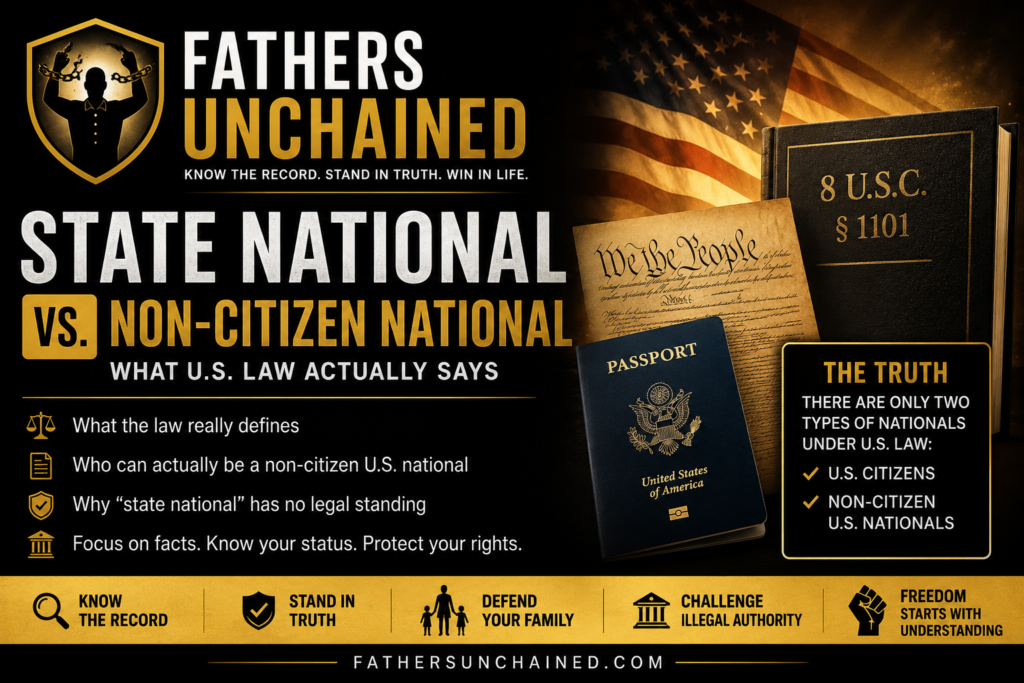
What Is a ‘National’ Under U.S. Law?
State National & Status Correction: What the Law Actually Says — Part 1 Educational purposes only. This article is not legal advice, does not create an attorney-client relationship, and should not be used as a substitute for reviewing the governing law or consulting qualified counsel about a specific case.Table of Contents
Introduction
Across social media, seminars, private groups, and downloadable document packages, people are often told that they can “correct their status,” declare themselves a “State National,” and thereby change their relationship with federal or state government. Some versions claim that a passport application, affidavit, UCC filing, birth-certificate amendment, or declaration of political status can convert an ordinary United States citizen into a legally distinct national who is outside certain laws or court authority. These claims often rely on real words found in real statutes. That is why they can sound convincing. The federal law does recognize the word national. It also recognizes a limited category of people who are nationals of the United States but not citizens. The problem arises when those genuine legal concepts are stretched beyond what the statutes actually say. The starting question is therefore simple:What is a “national” under United States law?Answering that question requires separating ordinary language, constitutional citizenship, state citizenship, federal nationality, and privately created labels.
1. Begin With the Statutory Definitions
The Immigration and Nationality Act supplies the governing federal definitions. Under 8 U.S.C. § 1101(a)(21), the term “national” means a person owing permanent allegiance to a state. Under 8 U.S.C. § 1101(a)(22), a “national of the United States” means either:- a citizen of the United States; or
- a person who, although not a citizen, owes permanent allegiance to the United States.
2. “National” Is an Umbrella Term
A common statement online is: “I am a national, not a citizen.” Standing alone, that statement may be legally incomplete. Federal law treats “national of the United States” as an umbrella category. It includes citizens and the comparatively small class of non-citizen nationals. A citizen who says, “I am a national,” is therefore saying something true. But saying, “I am a national and therefore not a citizen,” does not follow unless the person independently qualifies for non-citizen-national status under the governing law. The distinction can be illustrated this way:- All U.S. citizens are U.S. nationals.
- Some U.S. nationals are not U.S. citizens.
- A personal declaration does not itself determine which category applies.
3. Who Are Non-Citizen U.S. Nationals?
The principal statute is 8 U.S.C. § 1408, titled “Nationals but not citizens of the United States at birth.” It identifies specific classes of people who acquire that status by operation of law. Among the statutory categories are persons born in an “outlying possession” of the United States after formal acquisition, along with certain children born outside the United States to qualifying non-citizen-national parents. The Immigration and Nationality Act defines the relevant outlying possessions as American Samoa and Swains Island. The Department of State likewise explains that only a relatively small number of people acquire U.S. nationality without citizenship and that the status generally arises through the specific statutes governing American Samoa, Swains Island, qualifying parentage, and narrow historical provisions. This is crucial: the legal status arises from Congress’s nationality laws, not from a private choice of terminology.4. Status Is Usually Acquired by Operation of Law
Nationality law generally determines status through legally defined events such as:- place of birth;
- the status of a person’s parents;
- statutory residence or physical-presence requirements;
- naturalization; or
- specific historical legislation affecting a territory or population.
5. “Permanent Allegiance” Is Not a Self-Executing Escape Clause
Much of the online debate centers on the phrase “owes permanent allegiance to the United States.” Some argue that allegiance is purely voluntary and can therefore be redirected by affidavit. Others treat the phrase as though a declaration of allegiance to a particular state automatically replaces United States citizenship with non-citizen nationality. That conclusion does not appear in the nationality statutes. In this context, “permanent allegiance” describes a legal relationship recognized by law. It does not operate as a blank form that any person may rewrite privately. Courts and government agencies determine nationality by applying constitutional and statutory rules to facts such as birth, parentage, naturalization, and formal expatriation. Personal beliefs about political identity may be sincere and constitutionally protected in many settings. But sincerely adopting a political label is not the same as establishing a new legal nationality classification.6. Is “State National” a Federal Nationality Classification?
The phrases “State National,” “American State National,” “Constitutional National,” and similar terms are widely used in private materials. However, they are not listed as distinct nationality categories in 8 U.S.C. § 1101(a)(22) or 8 U.S.C. § 1408. This does not mean the word “state” is legally meaningless. The Constitution and federal statutes recognize state citizenship, state domicile, state residency, and political membership in a state. But those concepts do not automatically create a separate federal nationality that a person can elect in place of U.S. citizenship. A person can be, for example, a citizen of Tennessee and a citizen of the United States. That does not establish that the person is a federally recognized “Tennessee National” who is no longer subject to otherwise applicable federal or state law. The distinction between state citizenship and federal nationality will be addressed more fully later in this series.7. Real Statutes Can Be Used to Support an Unsupported Conclusion
Many status-correction arguments follow a recurring pattern:- A real statute is quoted.
- A real distinction is identified.
- An additional conclusion is inserted that the statute never states.
- It is true that all citizens are nationals.
- It is true that some nationals are not citizens.
- It does not follow that every citizen may become a non-citizen national by declaration.
Which statute authorizes this document to create that result?Not which statute contains similar words. Not which dictionary supplies a favorable definition. Not which private teacher says the process works. The question is what enacted law gives the particular filing the claimed legal effect.
8. Nationality, Citizenship, Domicile, and Jurisdiction Are Different Issues
Another source of confusion is the tendency to combine several distinct legal subjects. Nationality concerns a person’s legal relationship of allegiance to a nation. Citizenship concerns political membership and the rights and obligations attached to that status. Domicile generally concerns the place a person treats as a permanent home. Personal jurisdiction concerns a court’s authority to bind a particular person in a particular proceeding. Subject-matter jurisdiction concerns a court’s authority over the type of dispute presented. Changing an address does not necessarily change nationality. Declaring a political identity does not automatically defeat personal jurisdiction. Possessing a passport does not prove that service of process occurred. And a defect in service is not resolved merely by labeling the person a citizen or a national. Each issue must be analyzed under its own governing law and facts.9. Why This Matters in Family-Court and Child-Support Cases
Fathers involved in family-court or child-support proceedings may encounter claims that correcting political status will eliminate jurisdiction, erase an order, terminate arrears, or prevent enforcement. Relying on that theory can distract from stronger, record-based issues. Questions that may actually matter include:- Was a valid complaint or petition filed?
- Was process issued in compliance with applicable law?
- Was the respondent properly served?
- Does the record contain a completed return, affidavit, or proof of publication?
- Was legally sufficient notice provided?
- Did the person receive a meaningful opportunity to be heard?
- Did the court possess subject-matter jurisdiction?
- Was an order entered before jurisdictional prerequisites were satisfied?
- Did later conduct waive an objection under the controlling state’s law?
10. A Passport Does Not Let the Applicant Choose Any Status
The Department of State permits a person who believes that he or she qualifies as a non-citizen national to apply for appropriate documentation and submit proof. That is not the same as allowing every applicant to check a preferred political-status box and thereby alter nationality. The agency evaluates the evidence under federal law. A passport identifying someone as a non-citizen national reflects a status the government has determined already exists. The application process is evidentiary; it is not a private status-creation mechanism. Misrepresentations in passport applications can also carry serious consequences. Anyone considering a nationality claim should avoid unsupported statements and should review the official requirements carefully.11. Renouncing Citizenship Is Not the Same as Becoming a State National
Federal law provides formal procedures for loss or renunciation of United States nationality in specified circumstances. Those procedures are governed principally by 8 U.S.C. § 1481. Formal expatriation is not a process for becoming a protected “State National.” It may result in loss of U.S. nationality altogether, with significant immigration, tax, travel, property, and practical consequences. It also does not automatically erase existing debts, judgments, support obligations, tax liabilities, or court orders. Renunciation will be examined separately in Part 5 of this series.12. A Practical Research Method
Before relying on any status-related claim, apply the following test:- Identify the exact legal result being promised.
- Locate the statute that expressly authorizes that result.
- Read the statutory definitions.
- Review related statutes, regulations, and official agency guidance.
- Search for reported cases addressing the same theory.
- Distinguish proof of an existing status from creation of a new status.
- Do not sign government forms containing claims you cannot document.
13. The Bottom Line
Under federal law, a “national of the United States” is either a U.S. citizen or a person who, although not a citizen, owes permanent allegiance to the United States. Every U.S. citizen is already a U.S. national. A limited group of people acquire non-citizen-national status through specific statutes, principally involving American Samoa, Swains Island, qualifying parentage, and narrow historical provisions. The federal statutes do not establish a general process by which an ordinary citizen born in one of the fifty states can become a legally distinct “State National” merely through an affidavit, UCC filing, passport notation, or private declaration. That conclusion does not diminish legitimate challenges to defective service, lack of notice, absence of personal jurisdiction, or denial of due process. It keeps those challenges focused on the legal rules and evidence most likely to matter.Key Takeaways
- All U.S. citizens are also U.S. nationals.
- Only a limited statutory class consists of nationals who are not citizens.
- Non-citizen-national status is established by law, not private declaration.
- A passport application documents status; it does not freely create it.
- State citizenship and federal nationality are different concepts.
- Nationality labels do not substitute for record-based jurisdictional analysis.
Continue Learning
Part 2: Who Can Actually Be a Non-Citizen U.S. National? examines 8 U.S.C. § 1408, American Samoa, Swains Island, qualifying parentage, and narrow historical exceptions in greater detail. The complete supporting series is available through the Fathers Unchained Private Members Association.- Record Authority Starter Kit
- Find the Record Workshop
- Title IV-D: When America’s Family Courts Became State Actors
Frequently Asked Questions
What is a State National?
“State National” is a label used in private materials, but federal nationality statutes do not establish it as a separate nationality classification that a person may select instead of United States citizenship.Can a U.S. citizen become a non-citizen U.S. national by filing paperwork?
Federal law does not provide a general procedure allowing an ordinary U.S. citizen to acquire non-citizen-national status through an affidavit, UCC filing, passport notation, or private declaration.Does a passport application change legal status?
A passport application documents a status that exists under federal law. It does not give an applicant unrestricted power to create or select a new nationality classification.Who generally qualifies as a non-citizen U.S. national?
The principal categories arise under 8 U.S.C. § 1408 and generally involve birth in American Samoa or Swains Island, qualifying parentage, or narrow historical provisions.Does claiming State National status defeat court jurisdiction?
No nationality label automatically defeats jurisdiction. Personal jurisdiction, subject-matter jurisdiction, service, notice, waiver, and due process must each be examined under the governing procedural law and the actual court record.Primary Authorities and Official Resources
- 8 U.S.C. § 1101(a)(21)–(22), definitions of “national” and “national of the United States.”
- 8 U.S.C. § 1101(a)(29), definition of “outlying possessions of the United States.”
- 8 U.S.C. § 1408, nationals but not citizens at birth.
- 8 U.S.C. § 1452(b), evidence of non-citizen-national status.
- 8 U.S.C. § 1481, loss of nationality.
- U.S. Department of State: Certificates of Non-Citizen Nationality.
Fathers Unchained Stay informed, stay free, and stay unchained.